


A look at the past year shows how many social and economic challenges it had to offer. It is therefore only a matter of time before your employees reach their personal and professional limits due to this multiple burden if they do not receive the necessary support. Because in addition to personal concerns, employees are increasingly challenged in the professional context. The high workload triggers exhaustion, they suffer from stress and tension. With this burden, it is difficult to continue in a reasonable way.
In your role as a leader, you have the opportunity to support your employees in these times and give them orientation. If you enable your employees to form clear goal visions, they can draw strength for the new year from this positive target state and motivate themselves.
An ideal way to become aware of this year’s goal images is the wheel of life. What is meant by a wheel of life and how you can successfully use it with your employees is what we would like to reveal to you in this article.
What is behind the wheel of life?
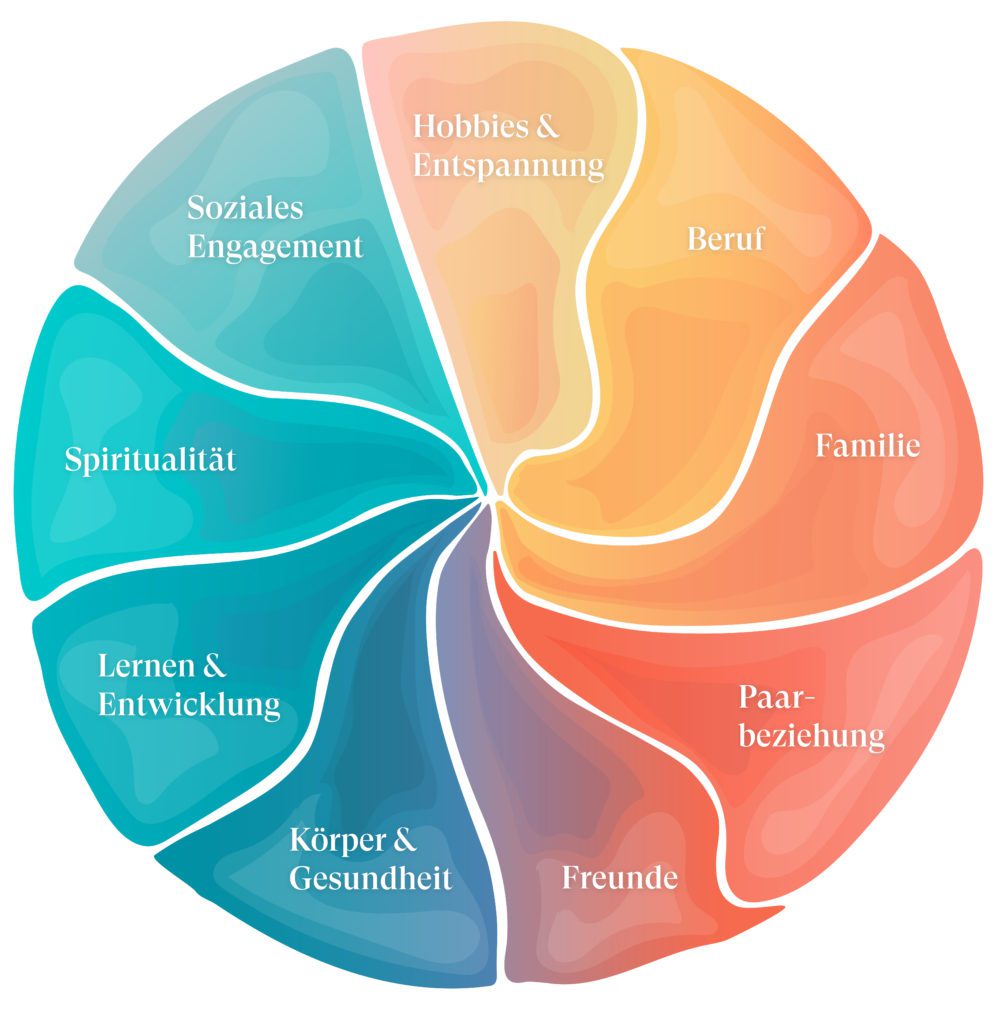
The wheel of life is a visual tool to set personal goals. For this purpose, personal needs are identified and goals are derived that align with one’s own core values. One analyzes the current life situation based on selected life areas and thus finds out how much time one spends in which life areas. The wheel of life thereby helps to recognize one’s own energy drainers and sources. Where do I want to spend more time and where less? What is needed to come back into balance?
What benefit does the wheel of life provide?
By working on their personal wheel of life, your employees find out what they can do to bring their life into balance and noticeably increase their quality of life. And employees who lead a balanced life are demonstrably happier, more focused and therefore also more productive.
The method is an ideal complement to the common goal-finding and goal-definition tools, so that you can use it in addition to existing exercises. The wheel of life thus helps to achieve one’s own goals more quickly and also provides helpful impulses for fundamental questions of life, such as “What is the meaning of life?” or “What is really important to me?”.
When your employees become aware of their current life situation, they recognize which areas they devote too much attention to and which areas they are still neglecting. If, for example, they invest too much time in their work and create no balance, this can have a negative effect on their health and performance and thus also harm the company. In this way, the wheel of life represents a snapshot of the current life situation. Instead of just going around in circles and having no concrete ideas about which areas to invest energy and attention in, one can consciously decide to change certain areas.
This is how you can easily support your employees with their wheel of life
In order for your employees to get to the bottom of their current life situation, it is suitable to organize a workshop in which they are guided through the wheel of life with the help of a moderator and work out their individual target state.
Otherwise, you can also give them the tool to work on it independently. Simply use the following step-by-step guide for this:
1. Determination of the life areas
Every person is structured differently, therefore every wheel of life is unique. In order for the wheel of life to perfectly reflect one’s own life situation, one first identifies the life areas that are important to oneself.
Possible life areas can be: Career, romantic relationship, family, friends, hobbies and relaxation, learning and development, spirituality, sleep and social engagement.
Are these areas complete? Or are there additional life areas to add?
2. Evaluation of the current life situation
After the relevant life areas have been defined, it is about gaining an overview of the current situation. It is about recognizing how the areas are lived differently and whether this corresponds to what one actually wishes deep inside. For this purpose, the status quo is evaluated by the respective level of satisfaction.
How much time is invested in each area? Is that sufficient? Satisfaction is rated on a scale of 1–10 and recorded.
3. Define the expectation horizon
Based on the current life situation, one now considers where it should go. What does the respective level of satisfaction trigger in oneself and how does one imagine the future? For this purpose, considerations are made about exactly where something should be improved.
By what percentage should which area increase? What might be missing in life? What can be changed concretely?
4. Time for reflection
Before continuing, one briefly reflects inwardly and lets the previous results sink in. Is the evaluation already accurate, or is something still bothering? Where are key points missing? Is the evaluation realistic or is the gap between actual and desired too large?
5. Determination of measures
Following the goal setting comes the concrete determination of measures. What must be done to bring about this change? Clear tasks are formulated that increase satisfaction in the individual areas and thus noticeably improve quality of life.
Conclusion
Not only in the professional context are goals needed that serve as guardrails and increase intrinsic motivation through future planning. Your employees also need guidance for their private lives that brings them into balance.
Only then can they use their valuable energy in a targeted and value-creating way. With the wheel of life, create a foundation for your employees to better contribute their potential within the company and start a promising year together with them.