


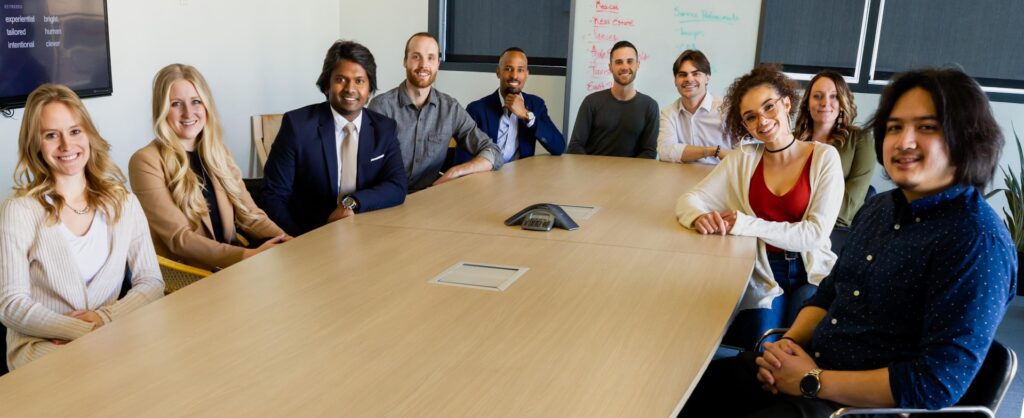
The invitation of an employee to an employee meeting marks an important point in the professional calendar, at which topics such as performance, behavior, goals and salary as well as the overall work situation are at the center. Such conversations are regarded as indispensable in modern personnel management. They offer employees the opportunity to receive feedback on their work and development opportunities as well as to address personal concerns and any conflicts in an open dialogue with the manager. In order for the employee meeting to become a complete success for employees, 7 tips are presented below that one should definitely take to heart!
What is the purpose of an employee meeting?
An employee meeting, also known as a personnel meeting, represents a central platform for the exchange between a manager and an employee. The primary purpose of this dialogue is to
- to enable mutual feedback,
- to make joint goal agreements and
- to articulate development wishes.
In addition, it serves as an opportunity to address and clarify open problems and conflicts within the working relationship. In many companies it is customary that such conversations are held at least once a year, but often also more frequently.
The effective conduct of an employee meeting can contribute significantly to the professional development of the employee and sustainably improve the quality of collaboration between employee and manager.
As a rule, such a conversation is structured from the following steps:
- Greeting and discussion of the course of the conversation
- Self-assessment, feedback and analysis
- Planning and goal agreement
- Perspective and development
- Conclusion of the conversation
Of course, the course can also vary, depending on what type of employee meeting it is, which mainly depends on the occasion of the dialogue.
The following are 7 tips for employees in an employee meeting
#1 Tip: Create an understanding of the framework conditions
The conduct of employee meetings varies from company to company. In order to be optimally prepared for the conversation, it is advisable to inform yourself in advance about the specific conditions in your own company, such as among others:
- The regularity of the employee meetings
- The list of participants in the conversation
- The usual duration of an employee meeting
- The main topics that are typically addressed
With a clear understanding of these framework conditions, one can adjust and prepare more effectively for the conversation, for example through targeted self-reflection within the available time frame. In addition, it enables a better adaptation to the conversation partner and their possible particularities.
#2 Tip: The right preparation
Comprehensive preparation is the key to the success of every employee meeting. The following three aspects are particularly decisive:
Prepare data and facts
It is advisable to review the past months and evaluate in which tasks or projects successes were achieved and in which moments difficulties occurred. An analysis of the reasons for these problems and considerations of how such challenges could be addressed in the future are equally important. A review of previous employee meetings, in order to determine whether set goals were achieved and promised support measures were implemented, should also be carried out.
Personal performance assessment
The personal performance assessment includes the review and evaluation of performance by the manager, including the discussion of successes, strengths as well as potential for improvement. However, one can also prepare for this by assessing oneself objectively. Here it can again be helpful to refer to the record of the last employee meeting and go through the following questions:
- Has the performance improved since then?
- Were the goals agreed upon at that time achieved?
- Was more responsibility taken on?
Having the respective answers as well as plausible explanations, such as changed framework conditions or an increased workload, directly at hand not only conveys the impression of preparation having been done, but usually also meets with more understanding!
Analyze the relationship with the other person
The reflection of the personal relationship with the conversation partner is also an essential aspect in the preparation for an employee meeting for employees. Under no circumstances should one underestimate the personal relationship with one another, as this can significantly influence the course of the conversation! Ideally, one should deal in advance with these questions:
- What attitude do I have toward my conversation partner?
- How did previous conversations go?
- In which direction could the conversation develop?
- In which matters can agreement be assumed and when can objections be expected?
- What can one do if the conversation becomes emotional or takes a bad direction?
Note: If there is no good relationship with the conversation partner, it can also be beneficial to invite another person for neutral moderation!
#3 Tip: Prepare standard questions
Since employee meetings, as briefly mentioned earlier, are usually structured quite similarly, there are mostly certain standard questions that can arise with a high probability. These include among others:
- Is one satisfied with the current work situation?
- What motivates one most in the job?
- What is one currently working on?
- Is the collaboration within the team working smoothly or are there frictions?
- What were the greatest successes, challenges and setbacks since the last employee meeting?
- Does one need more support?
- What were the greatest learnings since the last employee meeting?
- What are the biggest challenges that are coming up in the near future?
- Where would one like to develop further?
- What expectations does one have for the future?
- Does one wish for feedback more often?
In most cases, an employee meeting also ends with open questions that offer the opportunity to address further concerns that have not yet been mentioned.
#4 Tip: Set and agree on professional goals
Within the framework of employee meetings, there is the opportunity to discuss both new professional goals and development opportunities as well as potential for improvement in the work environment. These goals can range from further training to taking on new projects up to desired positions. While some goals may already be set by the manager and are then explained, there is also the chance to define and negotiate them together in the conversation. It is important to come to these meetings with a clear idea of the goals that are personally regarded as realistic and desirable, which can above all include these two types of factors:
| Soft factors | Hard factors |
| Necessary changes at the workplace | Revenue increases |
| Minimum quantities | |
| Further training measures | Maximum rejection rate |
The definition of measurable goals and the clarification of the framework conditions for their achievement are essential in order to be able to assess performance objectively. In addition, one should formulate concrete personal goal ideas and wishes for the conversation. From maximum to minimum or alternative goals, in order for example to negotiate salary expectations or further training opportunities. The written documentation of the agreed goals including a time frame is indispensable in order to create a clear basis for future assessment and further development.
#5 Tip: The right behavior when it comes to feedback
In employee meetings, feedback on personal and social skills is a central aspect. It is important to recognize criticism, reflect on it and respond to it objectively, without becoming emotional, even if one’s own behavior is at the center. Especially these effective communication strategies can positively influence the course of the conversation:
- Establish references to everyday examples: It is beneficial to illustrate statements about strengths and development potential by means of concrete examples from everyday work. This enables the other person to be able to understand the perspective.
- Structure feedback meaningfully: Especially factors such as timeliness, that is addressing prompt and relevant feedback, avoiding generalizations and giving the other person sufficient space for reactions and presentation of their point of view, play an important role here.
- The sandwich principle: In this approach, a negative aspect is so to speak surrounded by two positive ones, which makes accepting the feedback considerably easier.
- Handling negative feedback: Of course, it is never pleasant to receive negative feedback. Nevertheless, it is part of professional as well as private life, which is why one should always remain calm in such situations and accept the feedback as constructive advice. In addition, feedback contributes to self-improvement, which is why one can view it as an opportunity and accept it gratefully. However, not every criticism must automatically be accepted and may also be refuted from one’s own perspective!
- Correct tone and choice of words: Nevertheless, it generally applies that even in cases of disagreement, respect and polite interaction must always be observed!
#6 Tip: Seize opportunities
In addition to feedback and performance evaluation, employee meetings are perfectly suited to seize new opportunities as an employee:
Salary
Within the framework of employee meetings, the topic of salary is often a central point of discussion, whereby a salary adjustment usually lies between five and ten percent. It is important to determine the desired salary in advance, based on the industry-standard wages within the company.
Note: This amount should always be set somewhat higher for negotiation purposes in order to have a certain margin!
In addition, a personal pain threshold should be defined and strategies should be developed for the case that the offered salary lies below it, by for example mentioning alternatives such as additional benefits. If the salary demand is rejected, it is advisable to ask which performances could lead to a salary increase.
Professional development
Likewise, in the course of an employee meeting, one should as an employee take the opportunity to address the topic of promotion. It is important to convincingly present why one is particularly suited for a higher-level position. The manager should be able to recognize how a promotion of the employee would have a positive impact on the company.
Further training
Further training is another important topic. Therefore, in the conversation one should also emphasize one’s own motivation for professional further training and explain how specific training measures can not only expand personal competence, but also directly contribute to the benefit of the company.
#7 Tip: Maintain engagement after the conversation
The end of an employee meeting at the same time marks the beginning of the preparation for the next one. It is important to learn from the conversation, to regularly obtain feedback and thus ensure that one is on the right path. This continuous feedback makes it possible to learn from experiences and to advance one’s own professional development.
Conclusion: Effective preparation and active participation for successful employee meetings
Employee meetings are essential components of personnel management that contribute significantly to professional development and employee retention. Thorough preparation and active participation in these conversations enable employees not only to receive valuable feedback, but also to effectively communicate their career goals and personal concerns. By observing the seven tips presented, employees can ensure that they get the maximum out of these conversations, whether by setting realistic goals, preparing for feedback or seizing development opportunities.